
Head:
Assoc. Prof. Tomislav Terzić, PhD
E-mail: tterzic@uniri.hr
Tel: +385 51 584 626
Research lines developed at the Division
Research in the field of astrophysics is observational and theoretical. It includes investigation of the atmosphere of various types of stars, with particular focus on the Sun, sky surveys in the optical range, as well as gamma-ray observations through detection of Cherenkov radiation.
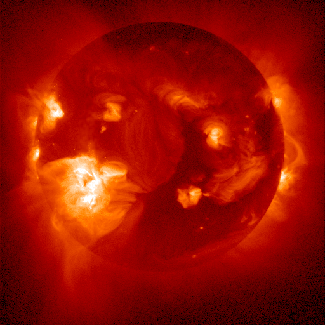
We investigate cataclysmic variable stars and especially symbiotic stars with spectroscopic and photometric methods. We study variations of helium lines of the Sun’s chromosphere and coronal holes observed in the microwave spectral range. Properties of the solar velocity field (rotational, meridional and azimuthal flows, their correlation and covariance, Reynolds stress) indicated by motions of the sunspot groups are investigated in order to reveal the transfer of the angular momentum from higher to lower latitudes and to maintain the current differential rotation profile. We study dependence of solar rotation on time and on the phase of the solar cycle, as well as the relationship between solar rotation and activity (R. Jurdana-Šepić, I. Poljančić-Beljan, K. Lončarić, T. Jurkić, S. Mićanović).
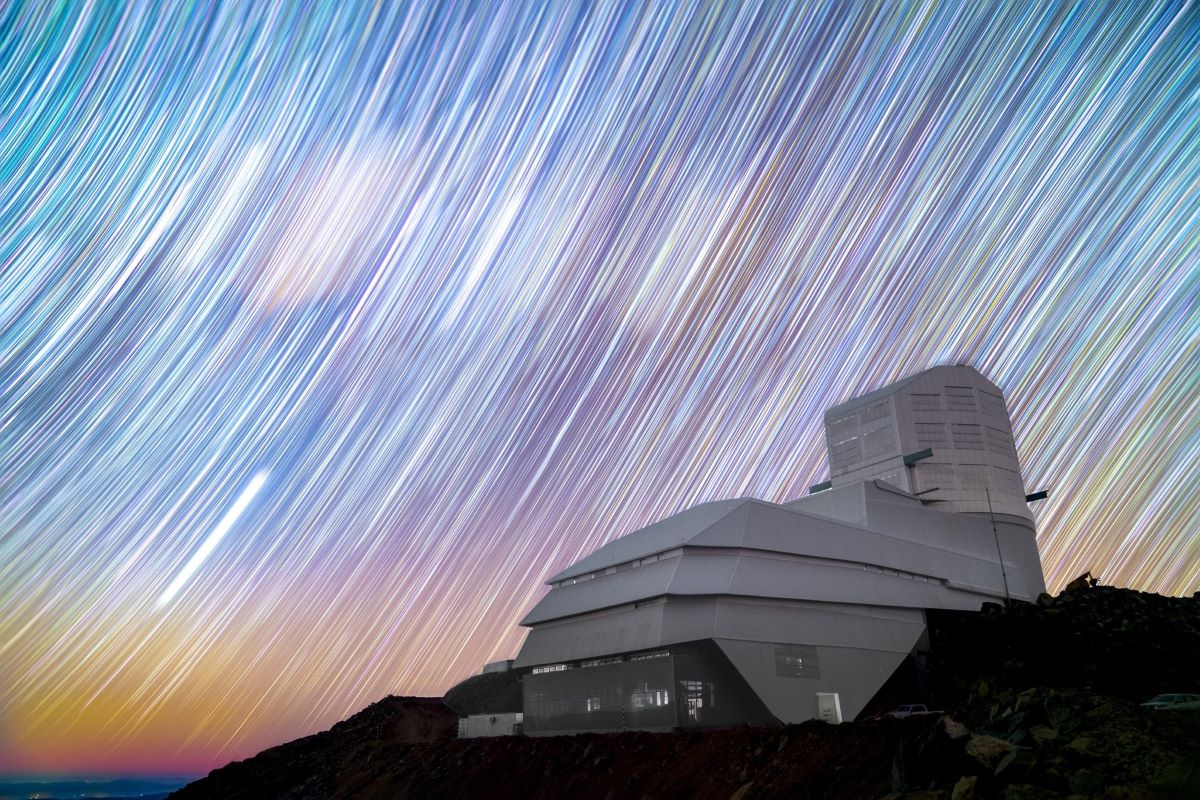
The LSST is the largest sky survey ever undertaken in the history of astronomy. Just in its first month of operation, it will see more of the universe than all telescopes combined throughout human history. LSST runs at Vera C. Rubin Observatory in Chile, and it will observe the entire southern sky every three days over the course of 10 years, obtaining the largest and the longest ever colour movie of the universe by creating the largest astronomical database of 40 billion stars and galaxies. Using modern methods such as machine learning and artificial intelligence, we study stellar populations and the structure of our galaxy, potentially hazardous asteroids, variable stars, and white dwarfs in systems that can lead to supernova eruptions (T. Jurkić, K. Mrakovčić).
Using Cherenkov telescopes CTAO-LST and MAGIC located at Canary island La Palma (ORM) we observe scattering of gamma rays in Earth’s atmosphere. Based on the analysis of light curves and gamma-ray spectra, we model physical phenomena in extreme conditions: active galactic nuclei (AGN), gamma-ray bursts (GRB), pulsars, starburst galaxies, and supernovae, as well as investigate the structure of spacetime. The Faculty of Physics of the University of Rijeka is co-owner of MAGIC telescopes and accompanying experimental equipment. We are also involved in the design and development of the first wide-filed Cherenkov detector in the southern hemisphere SWGO.
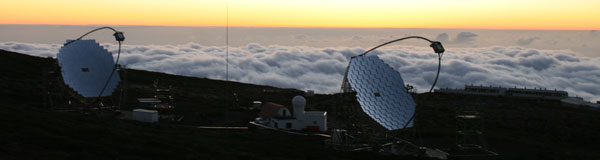
For more details on our activities with CTAO, MAGIC, and SWGO check out Laboratory for Astroparticle Physics (D. Dominis Prester, M. Manganaro, K. Mrakovčić, F. Reščić, and T. Terzić).
Research in theoretical physics covers a wide range of phenomena from Compton scattering on atoms, physics of lower-dimensional gauge and gravity theories, to thermodynamics of black holes and unification of forces.
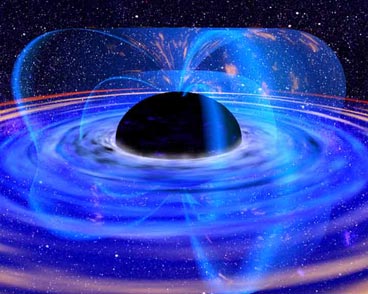
Gravity still eludes a full quantum description for various reasons. It is therefore worth trying different alternative approaches to the description of gravity and other fundamental fields. One of these approaches relies on higher spin theory (where the spin is greater than 2). There are various indications that it could contribute to a better behavior of theoretical models at high energies. It is also interesting to observe the field theories that describe the class of “continuous / infinite spin particle” particles. Common properties of these theories are a certain amount of non-locality, an infinite number of degrees of freedom at each point of space-time and an unconventionally represented Lorentz group, properties that are not present in the usual “textbook” approaches to quantum field theories, and which could allow a more complete understanding of gravity and quantum field theories at high energies. (M. Paulišić in collaboration with P. Dominis Prester from the Faculty of Mathematics).
A line of research being pursued focuses on 2D and 3D Chern-Simons gravity and their conformal boundary theories (or an ensemble of such theories). On the gravity side, the research centers on solving the partition function and describing the geometry in non-relativistic regimes. Meanwhile, research on the boundary theories focuses on their role in describing the quantum phases of condensed matter models, particularly in the context of fractional quantum Hall states (A. Ranjbar).
We extended the study of Compton scattering on atoms with an independent particle model to double-ionised helium atoms with corrections from Coulomb and magnetic interaction. We also study scattering on two centres, for example scattering on positronium (Z. Kaliman).
We perform research of magnetism, in particular spintronics, a research field focused on using electron spin for data recording, storing, and transfer (V. Labinac)..
Membership in international research collaborations
- CTAO – Cherenkov Telescope Array Observatory (D. Dominis Prester, M. Manganaro, K. Mrakovčić, T. Terzić)
- LSST – Large Synoptic Survey Telescope (T. Jurkić, K. Mrakovčić)
- MAGIC – Major Atmospheric Gamma Imaging Cherenkov (članovi: D. Dominis Prester, M. Manganaro, T. Terzić)
- SWGO – Southern Wide-field Gamma-ray Observatory (J. Isaković, M. Manganaro, F. Reščić, T. Terzić)
- NuGrid (M. Manganaro)
Projects
Scientific papers (CC/WoS)
Staff
- Prof. Rajka Jurdana-Šepić, PhD
- Prof. Dijana Dominis Prester, PhD
- Assoc. Prof. Marina Manganaro, PhD
- Assoc. Prof. Christian Pfeifer, PhD
- Assoc. Prof. Tomislav Terzić, PhD
- Assist. Prof. Tomislav Jurkić, PhD
- Assist. Prof. Saša Mićanović, PhD
- Assist. Prof. Ivana Poljančić Beljan, PhD
- Assist. Prof. Arash Ranjbar Zidehi, PhD
- Velimir Labinac, Senior Lecturer
- Klaudija Lončarić, Senior Lecturer
- Mateo Paulišić, PhD
- Maykoll Anthonny Reyes Hung, PhD
- Karlo Mrakovčić
- Josiah Olumuyiwa Faniyi
- Filip Reščić